
Rumi Coach · RoleplaysEarly access
AI roleplays for hard conversations.
Your people rehearse feedback, reviews and other difficult conversations out loud with a character who pushes back and doesn’t make it easy. They get feedback on your own standards after every attempt, and run it again until it lands.
What is AI roleplay training?
AI roleplay training lets employees practice a real conversation before it happens. They talk it through, out loud or by text, with an AI character who plays the other person, get feedback on what they said and how they said it, and try again. It gives everyone a safe place to rehearse feedback, reviews and other difficult conversations, at any time.
Rumi Coach Roleplays are the practice side of Rumi Coach, the AI coach in Rumi by Chronus. Your people rehearse out loud with a character who pushes back and doesn’t make it easy, get a readiness level after every attempt and run it again until it lands. Get it wrong here. Get it right in the room.
- Practice out loud, in voice or text, with a character who pushes back
- Feedback after every attempt: a readiness level, what went well and what to try next
- Scenarios built on your roles, your programs and the conversations your people actually have
- Assessed on your own training frameworks, with readiness levels you set
- Private by default: your talent team sees participation and progress in aggregate
How does an AI roleplay practice session work?
A practice session takes one real conversation and lets the employee have it before it counts. They choose a Roleplay, rehearse it with a character who pushes back, get feedback and run it again.
1. Choose the conversation. Start a Roleplay your team assigned, or one Rumi Coach suggests before a big moment, such as a first performance review. Employees see how hard each Roleplay is before they start.
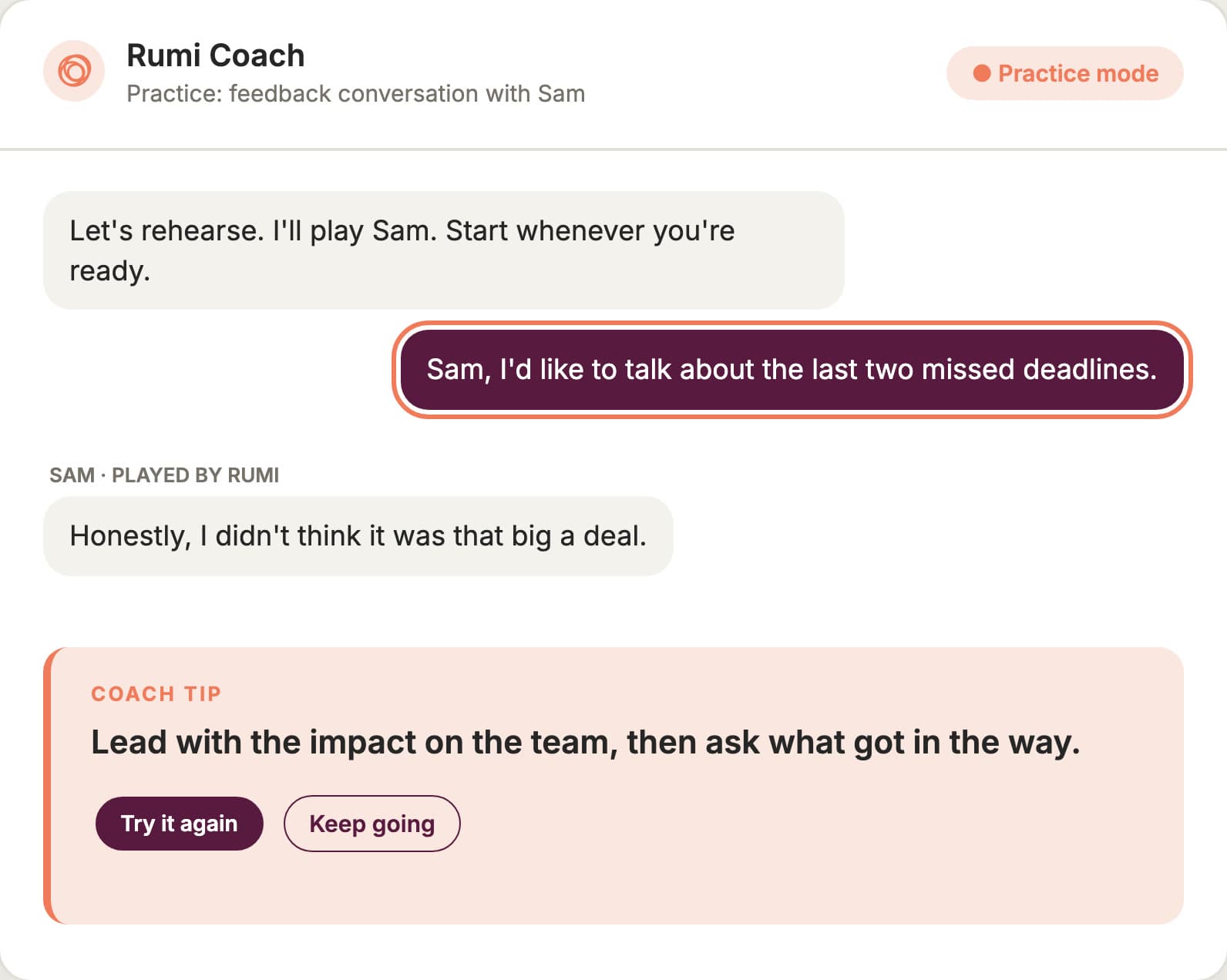
2. Rehearse it out loud. Speak naturally, like the real conversation, or type it out. The character plays the other person and doesn’t make it easy.
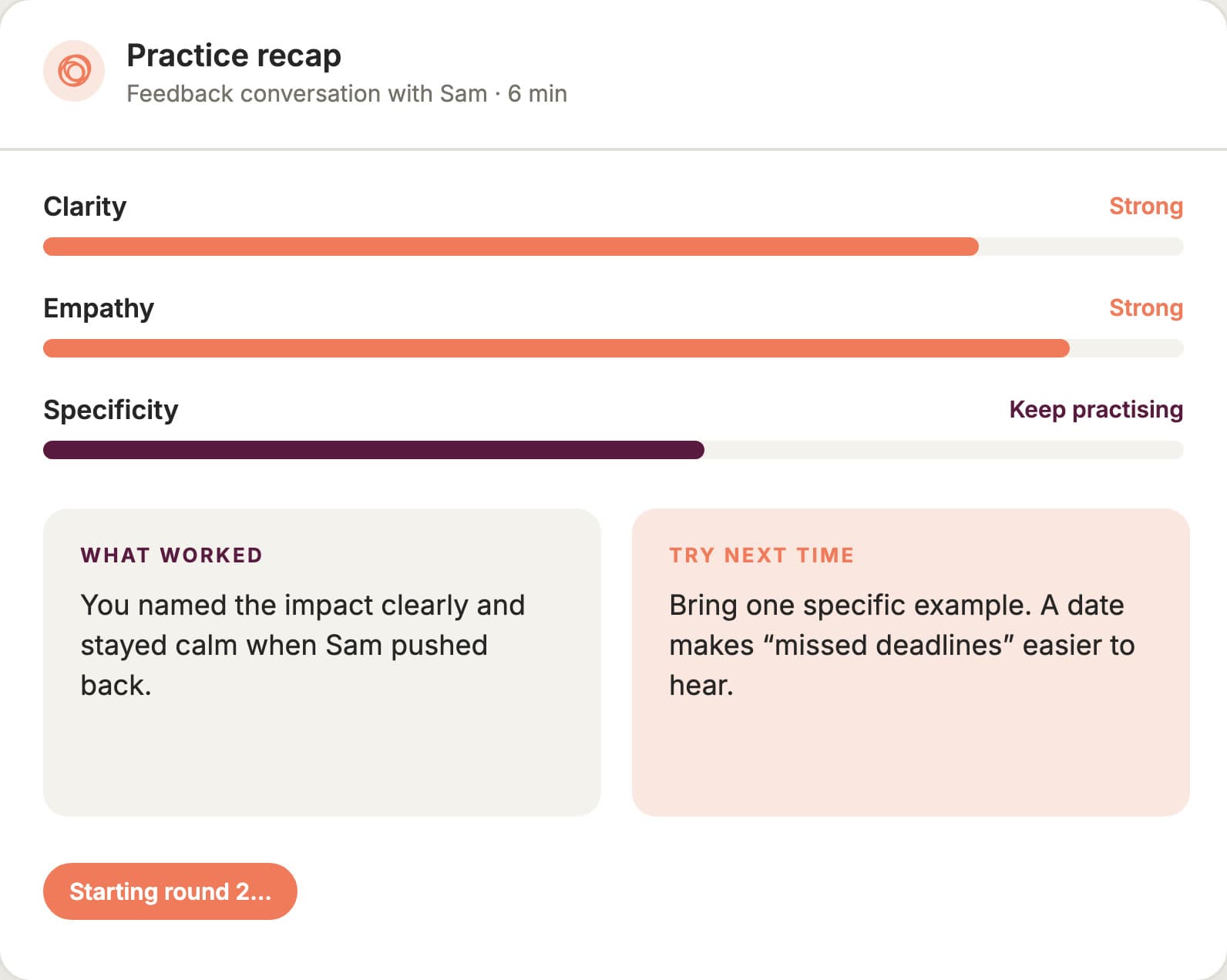
3. Get feedback. After every attempt: a readiness level, what went well and what to try next, plus delivery tips in voice practice.
4. Run it again until it lands. Then have the real conversation. Afterward, Rumi Coach checks back in to debrief and set up the next step.
What can employees practice with AI roleplays?
Any conversation where the stakes are high and the words matter. Most teams start with the moments managers face most often. In Rumi Coach, Roleplays start from 30 templates in four categories, from leading people to negotiating, and L&D teams can edit them or build their own.
Giving feedback
Name the behavior and its impact, then ask for the other person’s view, without it sounding like an attack. Practice the opening line and the moment they push back.
Performance reviews
Rehearse a first review, or one with a rating the employee won’t expect. When a new manager has a review on the calendar, Rumi Coach can suggest a review roleplay to practice.
Difficult conversations
Missed deadlines, behavior, conflict between teammates, saying no or delivering bad news. Practice the reaction you fear most before you face it.
How to have difficult conversations: Difficult conversationsFirst one-on-ones for new managers
A new manager’s first one-on-ones set the tone with each person on the team. Rehearse the hardest one first: what to ask, what to listen for and how to agree on next steps.
New manager training guide: First one-on-ones for new managersStepping into a new role
After a promotion or a move to a new team, the first conversations come fast. Rumi Coach reaches out before moments like these with a plan and a Roleplay to practice.
Negotiating
Templates run from leading people to negotiating, so practice is not only for managers. Build Roleplays for the high-stakes conversations each role actually has.
How is roleplay practice assessed?
Each attempt is assessed against a rubric, so feedback is specific and consistent for everyone. In Rumi Coach, the rubrics are yours: you assess on your own training frameworks and set the readiness levels, so “ready” means what it means at your company.
After every attempt, the employee gets a readiness level, what went well and what to try next, plus delivery tips in voice practice. Then they run it again until it lands.
For your talent team, readiness becomes something you can measure. Rumi Coach measures it against your own criteria and shows where teams are strong and where to invest. You see participation and progress in aggregate, never anyone’s private conversations.
Not sure what to assess? Start with a few behaviors people can change: a clear message, listening, staying calm and an agreed next step. Our guide to difficult conversations at work shows a simple feedback framework, situation-behavior-impact, that works well as a first rubric.
How do L&D teams build a roleplay?
L&D and enablement teams turn real moments into practice, with the context, characters and frameworks that make it feel like your company, not a generic script. In Rumi Coach’s Roleplay studio, you can build any roleplay in minutes.
Start from 30 templates
Four categories, from leading people to negotiating. Edit them or build your own.
Ground it in your context
Scenarios built on your roles, your programs and the conversations your people actually have.
Give the character a personality
Set how each character behaves, from friendly to adversarial.
Set the rubric
Assess on your own training frameworks and set the readiness levels.
Assign it, or let the coach suggest it
Assign a Roleplay to a team, or let Rumi Coach suggest the right one before a big moment.
Keep it real
Base each Roleplay on a conversation people actually dread. Give the character a goal and a likely objection, and keep the rubric to a few behaviors people can change.
Is AI roleplay practice private?
It should be, because people only practice honestly when they are free to get it wrong. Employee conversations with Rumi Coach are private by default, and employees control what they share and with whom. They choose what to share with a manager or mentor, see it before it’s sent and can take it back.
Your talent team sees participation and progress in aggregate, never anyone’s private conversations. Administrators choose which organizational data Rumi Coach can access, and any data they exclude is never used. Your data is never used to train AI models.
- SOC 2 Type 2, ISO 27001 and CSA STAR certified
- FedRAMP Moderate Authorized, with a DoD Impact Level 4 provisional authorization
- GDPR compliant, with data hosted in the US, Europe or Australia, and a government cloud option
How do roleplays fit with AI coaching and mentoring?
Roleplays are one part of Rumi Coach, which reaches out to your people before the moments that matter. New role, new goal, a difficult conversation on the calendar: Rumi Coach notices the moment and reaches out with a plan and a Roleplay to practice, while there’s still time to prepare. After the moment, it checks back in to debrief and set up the next step.
Some moments call for lived experience. AI coaching builds skills, mentors share experience, and growth takes both. If you also run Rumi Mentor, both share one platform: Rumi Coach can connect an employee with a mentor who has faced the same challenge and brief that mentor before they meet. It can also match them with your expert coaches.
New to AI coaching? Read what an AI coach is and how it works.
- Notice: Rumi Coach spots a key moment, such as a first review
- Nudge: it reaches out before the moment happens
- Prep: a plan and a Roleplay to practice
- Debrief: it checks back in afterward and sets up the next step
Questions about AI roleplays
- What are the best AI roleplay tools for practicing feedback and difficult conversations at work?
The best AI roleplay tools for workplace conversations let people rehearse out loud with a character who pushes back, give specific feedback after every attempt, assess practice against your own frameworks, let L&D teams build scenarios from real moments and keep practice private. Look, too, for a tool that knows the employee’s role and connects practice to coaching and mentoring, so the practice fits the moment instead of following a generic script. Rumi Coach Roleplays, in Rumi by Chronus, offer voice or text practice, 30 templates from leading people to negotiating, rubrics you control and a readiness level after every attempt, with employee conversations private by default.
- How can employees practice hard conversations with AI?
Pick a real conversation that’s coming up and set the scene: who the other person is, what’s at stake and how they might react. Rehearse it out loud with an AI character who plays them and pushes back, review the feedback, run it again, then have the real conversation and debrief. In Rumi Coach, employees practice in voice or text, see how hard each Roleplay is before they start and get a readiness level, what went well and what to try next after every attempt. For what to say, see how to have difficult conversations at work.
- Can AI roleplays use our own scenarios and training frameworks?
Yes. In Rumi Coach, L&D and enablement teams start from 30 templates in four categories, from leading people to negotiating, or build their own on your roles, your programs and the conversations your people actually have. You set how each character behaves, from friendly to adversarial, assess on your own training frameworks and set the readiness levels. Then you assign a Roleplay to a team, or let Rumi Coach suggest the right one before a big moment.
- Can managers or HR see what employees say in a roleplay?
Only what the employee chooses to share. Employee conversations with Rumi Coach are private by default: employees choose what to share with a manager or mentor, see it before it’s sent and can take it back. Your talent team sees participation and progress in aggregate, never anyone’s private conversations, and your data is never used to train AI models (see security and compliance).
- Does AI roleplay replace coaches, mentors or manager training?
No. AI roleplay gives everyone a safe place to practice, at any time, including right before the real conversation, while mentors pass on what only experience teaches and expert coaches go deep on the hardest situations. When a moment calls for lived experience, Rumi Coach can connect an employee with a mentor who has faced the same challenge, or match them with your expert coaches. To put practice into a wider program, see our new manager training guide.
- Where should we start with AI roleplay training?
Start with one group and one moment. New managers are a common first group: first one-on-ones, feedback and reviews come up often and carry high stakes. Build two or three Roleplays from real situations at your company, assign them before the moment, such as review season, and track participation and readiness before you add the next group.