Blog
Why AI Adoption Fails: Enterprise Barriers to AI Leaders Ignore

Enterprise AI adoption is rising fast, but 95 percent of AI pilots fail, according to an MIT study. Only 5 percent of pilots generate a return on investment.
What are most organizations doing wrong? Hint: it’s not a tool problem. Learn the real barriers to AI change initiatives and how leaders can build a successful AI strategy.
AI Adoption Is Exploding, So Why Are Most Projects Stalling Out?
Personal AI usage is skyrocketing. KPMG’s data show that nearly 40 percent of U.S. adults aged 18 to 64 reported using generative AI within two years of its release. Compare that with the rollout of the internet, which saw only 20 percent adoption in its first two years of widespread availability.
AI Adoption Statistics and Enterprise Adoption Trends (2024–2026)
AI adoption is also accelerating at organizations across regions, industries, and business sizes, per McKinsey research. Eighty-eight percent of survey respondents said that their organizations used AI in at least one business function in 2025, compared to 55 percent in 2023.
However, only 7 percent of respondents said that AI was fully deployed and integrated across their organizations. And MIT’s data show that AI-related structural change is disproportionately concentrated in industries like tech and professional services. Other sectors like health care and pharma, financial services, and retail have seen fewer effects from AI technology.
Further, enterprises reported the lowest rates of pilot-to-scaled initiative conversion in MIT’s survey. They also moved considerably slower than midmarket organizations: nine months or longer on average for enterprise scaling versus 90 days for midmarket full adoption.
Enterprise adoption isn’t bogging down due to the quality of the data models. The problem is organizational readiness, and bridging that gap requires training, workflow redesign, and trust.
The AI Adoption Curve and Why Many Companies Stall in the Middle
AI adoption is moving more quickly than traditional technology adoption and requires new models for evaluation. Below, we compare the traditional Technology Adoption Curve with the AI Adoption Curve.
The Technology Adoption Curve
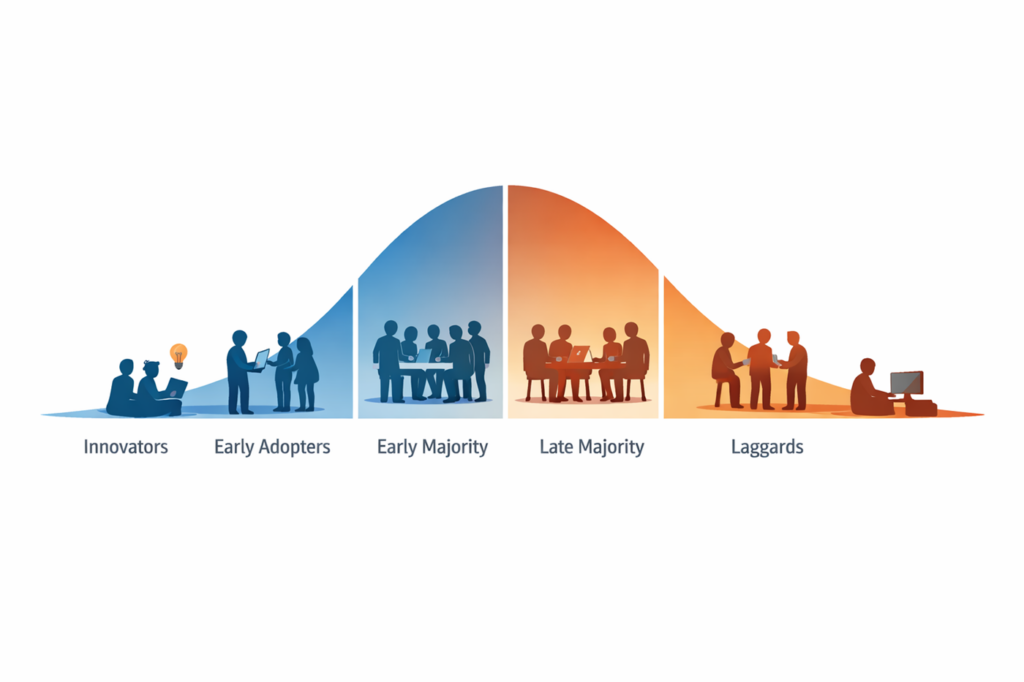
Popularized by Everett Rogers in his 1962 book, “Diffusion of Innovations,” the Technology Adoption Curve is a bell-shaped model that describes the acceptance of new technologies. The curve is split into five demographic groups:
- Innovators (2.5%): The cutting-edge of adopters who are willing to take a risk on a new technology.
- Early Adopters (13.5%): Trendsetters who see the strategic potential of the technology.
- Early Majority (34%): Pragmatists who wait for proof of success before adopting.
- Late Majority (34%): Conservative adopters, a.k.a., skeptics. This group waits for the technology to become standard before adopting it.
- Laggards (16%): Resistors who avoid adopting the technology until it becomes absolutely necessary.
Many innovations fail to bridge the gap between Early Adopters and the Early Majority. This adoption gap, called The Chasm by organizational theorist Geoffrey A. Moore, explains why some products and services fail to reach mainstream success.
The AI Adoption Curve
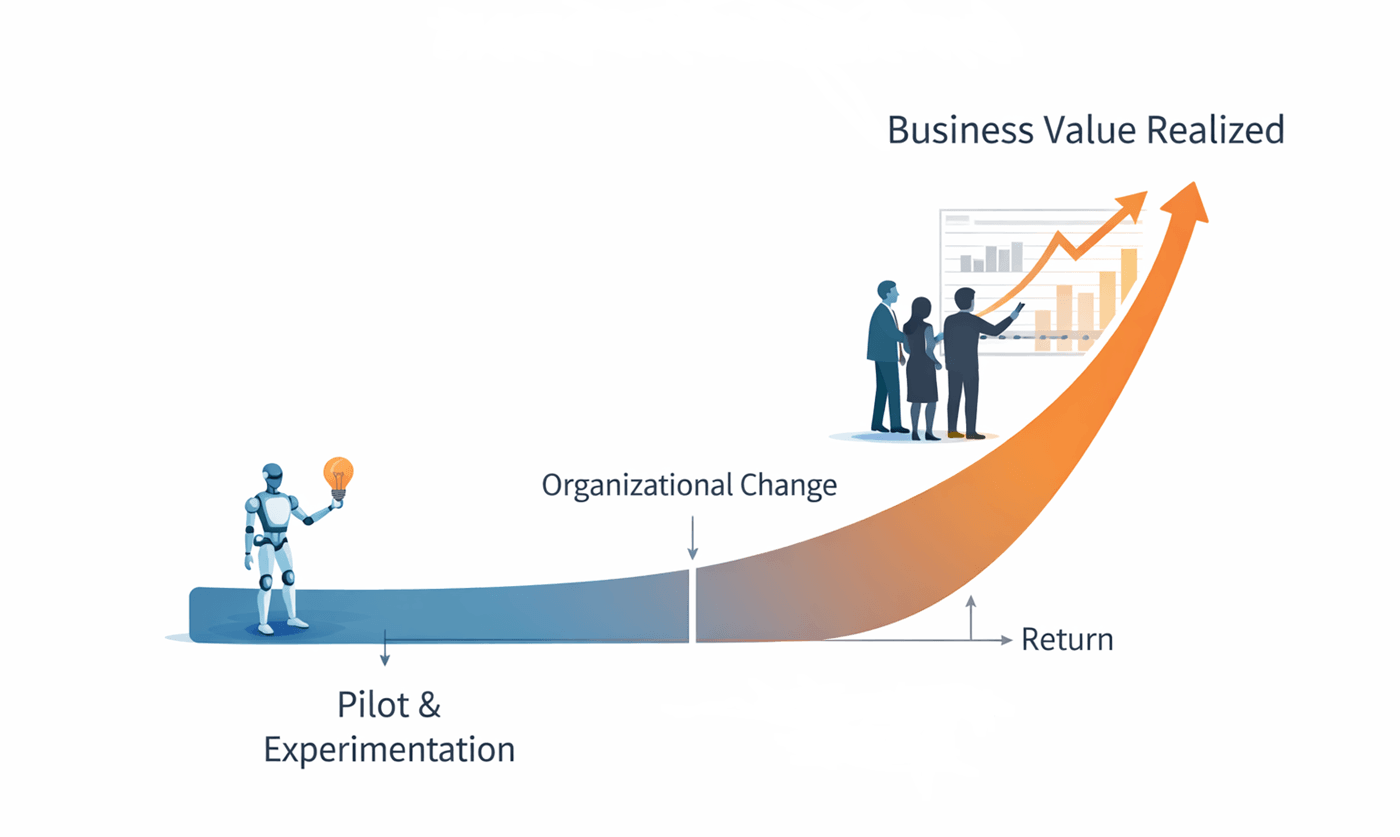
However, the AI change adoption curve follows a three-phase J-shaped pattern instead of the classic bell curve. This model is split into three phases:
- Pilots & Experimentation
- Organizational Change
- Business Value Realized
The “chasm” in the AI change adoption lies in the second phase; that’s where many organizations get stuck. Nearly 62 percent of respondents to McKinsey’s survey say that their orgs are experimenting with AI agents, but two-thirds say that their companies have not yet started scaling AI across the enterprise.
As a result, only slightly more than a third report realizing ROI from AI deployments. McKinsey’s data show that while 64 percent of respondents report that AI is enabling innovation, just 39 percent report EBIT impact. The 6 percent of respondents who report EBIT impact of 5 percent or greater (called “AI high performers” in McKinsey’s report) focused on:
- Redesigning workflows
- Scaling faster
- Implementing best practices
- Investing more
These high performers may also be willing to wait out a temporary lag between efforts and results. Research from MIT Sloan School of Management shows that productivity declines directly after AI adoption, only to rebound and improve beyond baseline over time. “Digitally mature” firms saw the fastest productivity growth, and established companies were slower to recover.
“Firms that have already done the digital transformation or were digital from the get-go have a much easier ride because past data can be a good predictor of future outcomes,” said University of Toronto professor Kristina McElheran, a lead author of the new paper, The Rise of Industrial AI in America: Microfoundations of the Productivity J-Curve(s). “Once you solve those adjustment costs, if you can scale the benefits across more output, more markets, and more customers, you’re going to get on the upswing of the J-curve a lot faster.”
AI Project Failure Rates and the Reality Behind the Hype
Determining true AI failure rates is tricky in part because most enterprise AI initiatives haven’t had time to grow from pilot to realizing business value. A more useful way to look at this may be to examine where AI projects stall and what’s needed to move forward. That’s what the 95 percent stat from MIT’s analysis actually refers to, and that’s where you’ll discover ways to ensure the success of your pilots.
Before organizations see measurable business outcomes, they typically:
- Redesign processes and workflows
- Integrate AI tools into the work, instead of using standalone tools
- Invest in learning and build trust
Notably, switching tools is rarely a quick fix. High-performing AI adopters focus on integrating tools into the work, rather than expecting point solutions to bridge gaps.
What Is AI Adoption in a Business Context? Understanding the Full Organizational Shift
Enterprise AI adoption means moving beyond isolated AI experiments to transforming work at the organizational level and generating business value. It’s not just a matter of selecting the right tools. It’s ensuring that AI initiatives are aligned with business goals and processes, that infrastructure and data quality are up to the challenge, and that employees are trained and supported.
Adoption of AI Across Industries
AI use is unevenly distributed across company sizes and industries, according to McKinsey’s research. For example, the use of AI agents (software programs that are able to make multi-step decisions without human intervention) was most common in the technology, media & telecommunications, and health care sectors. However, no more than 10 percent of respondents to McKinsey’s survey reported scaling agents in any function.
Meanwhile, larger companies were more likely to report scaling AI projects beyond the pilot stage. Enterprises with annual revenues of greater than $5 billion were the most likely to report fully scaling an AI project, but only 10 percent of those orgs had reached that level.
Global AI Adoption Rates and Country-Level Differences
In the second half of 2025, 1 in 6 people used generative AI tools globally, according to the Microsoft AI Economy Institute. However, adoption in the Global North took place twice as quickly as adoption in the Global South; 24.1 percent of working people in the North used AI tools compared to 14.1 percent in the South.
Leading countries included the United Arab Emirates (64 percent), Singapore (60.9 percent), Norway (46.4 percent), Ireland (44.6 percent), France (44 percent), and Spain (39.7 percent). These nations invested in digital infrastructure, government legislation and support, and AI skilling. By contrast, the United States registered AI diffusion of 26.3 percent.
The UAE’s advantage provides a useful strategic lesson for companies about organizational readiness. The country invested in AI infrastructure and governance starting in 2017 — five years before ChatGPT hit the mainstream — with the appointment of the world’s first Minister of State for Artificial Intelligence. As a result, the 2025 Edelman Trust Barometer shows that UAE AI trust registers around 67 percent, compared to U.S. AI trust of 32 percent.
The Biggest Barriers to AI Adoption Inside Organizations
Trust is essential to successful AI adoption, and a lack of trust constitutes one of the biggest barriers to adoption. However, there are other pitfalls to keep in mind as well.
What Are Some of the Biggest Challenges to AI Adoption?
Organizational resistance: Fear of automation is one of the most substantial — and understandable — challenges facing AI-forward companies. About half of workers say that they’re worried about the future impact of AI in the workplace, according to Pew Research. Nearly a third say that they’re concerned about fewer job opportunities due to AI automation.
Lack of executive alignment and strategy: Fewer than half of respondents to an MIT Sloan survey said that their org’s AI policies reflected the reality of their work. Sixty-three percent said that delegating AI rule setting and implementation to team leaders (rather than to a centralized AI czar or the like) was necessary for strategic use.
Limited AI literacy across teams: Casual AI adoption may be growing, but that doesn’t necessarily lead to usage that’s aligned with business goals. Only 44 percent of U.S. workers report receiving AI training from their employers, compared to 80 percent of employees who are using AI at work. Fifty-seven percent say that they’re reluctant to tell their teams that they’re using AI. Mentoring and peer communities can help employees get up to speed quickly in a supportive environment.
Poor data quality and fragmented infrastructure: MIT Sloan’s research shows that the temporary productivity decline after AI tool adoption is due in part to “a deeper misalignment between new digital tools and legacy operational processes.” Organizations should expect to invest in data infrastructure as well as workflow redesign and training.
What Successful Organizations Are Doing Differently

What separates the 5 percent of companies seeing real ROI from those that stall at the pilot stage? An analysis of MIT’s report shows that these orgs:
1. Choose Tools That Adapt to Internal Processes
Third-party solutions were twice as likely to lead to successful deployments as homegrown ones, but not all tools are created equal. In addition, firms may be reluctant to switch once they’ve invested.
As one financial services CIO tells MIT, “We’re currently evaluating five different GenAI solutions, but whichever system best learns and adapts to our specific processes will ultimately win our business. Once we’ve invested time in training a system to understand our workflows, the switching costs become prohibitive.”
2. Integrate Tools Into Workflows
Effective tools are embedded directly into workflows instead of requiring users to navigate between applications. However, organizations should start by integrating tools into non-mission-critical processes, demonstrating value, and then expanding to broader adoption.
3. Start Simply
MIT’s sample showed the most success in categories with a low configuration burden and clear, visible results. Think code generation or document automation, not tasks with more complex internal logic like dynamic pricing or fraud detection.
4. Work Closely With Vendors During Early Deployment
Organizations with successful AI pilots treat implementation as an iterative process. This means working closely with software vendors to:
- Align customization with internal processes
- Benchmark tools based on business outcomes
- Refine deployments through early-stage challenges
5. Look Beyond Flashy Front-Office Use Cases
AI-forward companies saw gains like 40% faster lead qualification and 10% improvement in customer retention. It’s easy to focus on the front office and forget the benefits of automation for the back office.
“Front-office tools get attention, but back-office tools deliver savings,” MIT researchers write, noting that some of the most substantial wins were due to back-office automation. Efficiencies include cutting external providers in customer service and document processing ($2M to $10M annual savings) and reducing agency spend (30 percent decrease).
AI Adoption Frameworks That Actually Work
AI adoption frameworks are roadmaps to implementation and use that help organizations move from the pilot stage to full-scale deployment.
Example of an AI Adoption Framework?
Harvard Business School provides an example of a successful AI adoption framework that scaled effectively and generated real value. DBS Bank rolled out the PURE (Purposeful, Unsurprising, Respectful, and Explainable) framework in 2018 to evaluate AI use cases.
The PURE framework distills guidance to four questions:
- Is the use purposeful and meaningful?
- Will the results surprise customers?
- Does it respect customers and their data?
- Can the outputs be explained?
In addition, DBS established a Responsible Data Use Committee to review projects outside the framework. By 2023, responsible AI use generated $274 million in value for DBS.
What Are the 4 Stages of AI Adoption?
The four stages of enterprise AI deployment are:
- Stage 1: Experimentation and Pilots — This includes informal AI use with off-the-shelf tools like ChatGPT and formal pilot programs.
- Stage 2: Departmental AI Deployments — Organizations adopt AI for specific business cases, e.g., fraud detection, HR onboarding, or knowledge bases.
- Stage 3: Cross-Functional AI Integration — Breaking down data silos allows collaboration across teams and departments. Example: JPMorganChase’s in-house solution, OmniAI, helps employees find technical help, retrains models at speed to adapt to customer concerns, and supports portfolio managers.
- Stage 4: AI-Native Organizations — AI tools automate complex processes and work independently. Humans provide oversight and accountability.
What Are the 5 Pillars of an AI Framework?
AI frameworks typically include:
- Data infrastructure
- Governance and ethics
- Workforce skills
- Technology platforms
- Business integration
Measuring the ROI and Success of AI Adoption
If you can’t measure the impact of change, you can’t determine success, failure, or next steps to recalibrate. However, AI ROI remains hard to measure.
How Do You Measure the ROI of AI Adoption?
Consider capturing metrics like the following:
- Direct financial impact vs productivity improvements
- Cost reduction through automation
- Revenue growth from AI-enabled products
How to Measure AI Adoption Inside an Organization
Measure internal AI adoption by capturing:
- AI usage metrics across teams: Which teams are using AI tools and what outcomes are they seeing? Calibrate expectations according to needs for each use case.
- Workflow efficiency improvements: How much time, money, and effort are employees saving by using toolsets? Look at hard metrics like productivity and subjective measures like sentiment (which can be captured through employee surveys).
- Adoption rates vs. tool deployment: Are employees using the available tools, and if not, why not?
AI Success Is an Organizational Transformation
AI adoption doesn’t fail because the technology isn’t capable; it fails because the organization isn’t ready. Leaders can underestimate what it takes to move from experimentation to scale. The data is consistent: most companies can launch pilots, but far fewer can integrate AI into the day-to-day work that drives real business outcomes.
What separates the organizations that succeed is not the tools they choose, but how they operationalize them. They redesign workflows, invest in workforce capability, and align leadership around a clear strategy for where AI creates value. Just as importantly, they recognize that early friction (whether in productivity, adoption, or trust) is part of the process, not a sign of failure.
Enterprise AI adoption is ultimately an execution challenge. The companies that move beyond pilots are the ones that treat AI as part of how work gets done, not as a parallel initiative. And over time, that distinction is what determines whether AI remains an experiment or becomes a source of sustained advantage.
Share this post:
|