Blog
Types of Organizational Change and the Change Adoption Curve: How to Lead People Through Uncertainty

Organizational change is a constant for today’s enterprises. From digital transformation to restructuring and evolving workforce expectations, leaders today are navigating continuous disruption.
The organizations that succeed aren’t just those with the best strategy, but those that drive adoption. Understanding how change works and how people respond to it is what separates stalled initiatives from meaningful transformation.
Why Organizational Change Is Inevitable in Modern Business
Change is no longer episodic; it’s continuous. The real challenge is how organizations sustain performance while navigating it.
The Accelerating Pace of Organizational Transformation
Modern organizations are expected to transform while still delivering day-to-day results. That tension is where most challenges begin.
As McKinsey notes, leaders can’t afford to succeed at transformation or operations; they must succeed at both, simultaneously. In fast-moving environments, this makes change leadership a core business competency, not a supporting function.
Why Most Organizational Change Initiatives Fail
It’s tricky to find an exact statistic on the number of organizational change initiatives that fail. Some sources estimate as many as 70 percent (McKinsey) to 88 percent (Bain & Company) of projects fall short.
Often, the issue isn’t the strategy, but rather the adjustment. Organizations introduce new tools, systems, or structures without investing enough in training, workflow redesign, or employee support.
A clear example of this is AI adoption. Research from the MIT Sloan School of Management shows that ROI for AI adoption tends to follow a J-curve change model; initially, productivity dips, only to surge over time. The issue in these cases is adjustment costs. Orgs roll out AI tools without investing in infrastructure, training, or redesigning workflows.
“Once firms work through the adjustment costs, they tend to experience stronger growth,” said Professor Kristina McElheran, a digital fellow at the MIT Initiative on the Digital Economy, in MIT Sloan’s report. “But that initial dip — the downward slope of the J-curve — is very real.”
The Human Factor Behind Successful Change
At its core, the change process is a human one. And, regardless of the aim of your initiative, its success is tied to the attitudes, behaviors, and yes, feelings of your employees.
Gallup research shows that employee engagement affects everything from productivity and profitability to safety and shrinkage (a.k.a. theft). When employees feel connected and supported, they’re significantly more likely to embrace new ways of working.
But during uncertainty, employees often experience:
- Fear of the unknown
- Loss of control or status
- Overwhelm from new expectations
Leaders who acknowledge these realities and actively support their people through them are far more likely to see change succeed.
The Core Types of Organizational Change Leaders Must Navigate
Not all change is the same. Each type of transformation brings different challenges and requires a different leadership approach.
Strategic Change Initiatives
Strategic change involves shifts in direction, such as entering new markets or adopting new business models. These initiatives are often high-stakes and ambiguous, requiring leaders to align teams around a new vision while maintaining execution.
Structural Organizational Change
Structural change reshapes how work gets done, as well as altering the org chart. This type of change can include reorganizations, new reporting lines, or the centralization or decentralization of functions.
While necessary, these changes can disrupt productivity in the short term. Clear role definition and communication are essential to stabilize teams during the transition.
Technological and Digital Transformation
Digital transformation is one of the most common (and most complex) forms of change.
Whether it’s implementing AI tools or new enterprise systems, resistance often stems from uncertainty and lack of confidence. According to Deloitte, lack of technical expertise and skills training are among the top barriers to AI adoption.
Cultural and Behavioral Transformation
Culture change is the most complex and the slowest part of transformation. It involves shifting mindsets, behaviors, and norms across the organization.
While structural changes can happen quickly, behavior takes time. As SHRM notes, culture is built through daily behaviors, not just leadership messaging.
Process and Operational Change
Operational changes focus on improving how work flows through new processes, policies, or efficiency initiatives. These changes often impact frontline teams the most, making clarity and practical support essential to avoid disruption.
Understanding the Change Adoption Curve in Organizations
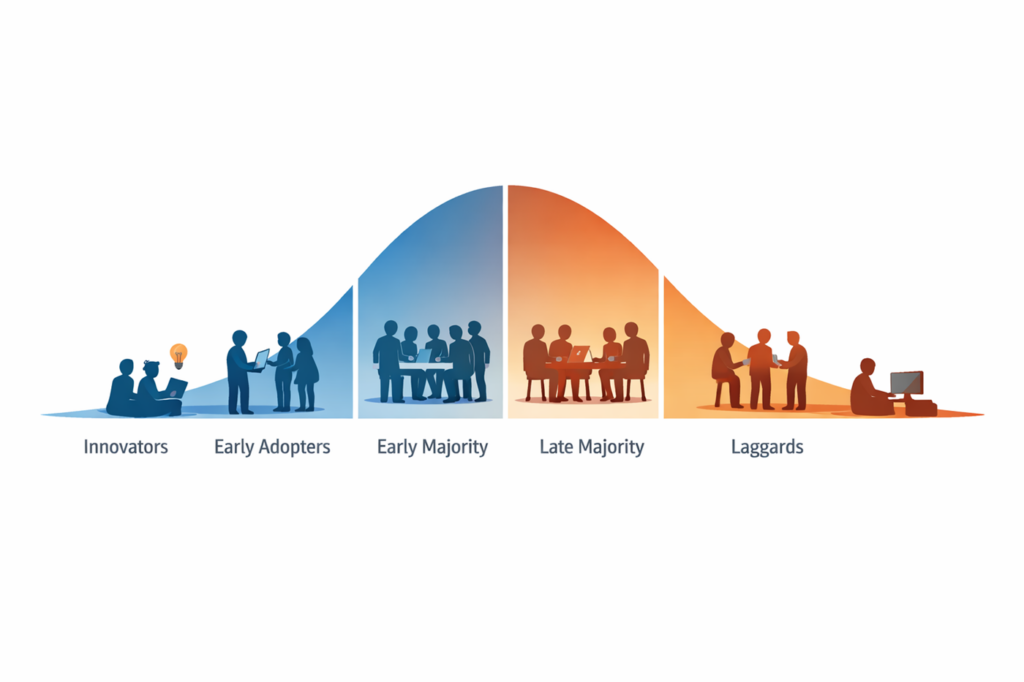
Every transformation follows a human pattern. Early adopters move first, others follow … and how leaders bridge that gap determines success.
Origins of the Change Adoption Curve
The Change Adoption Curve model, developed by Everett Rogers, explains how new ideas spread through groups. It segments people based on how quickly they adopt change.
The 5 Groups in the Change Adoption Curve
- Innovators (2.5%): Early experimenters willing to take risks
- Early Adopters (13.5%): Influential advocates who shape perception
- Early Majority (34%): Pragmatic adopters who look for proof
- Late Majority (34%): Skeptical employees needing reassurance
- Laggards (16%): Resistant individuals tied to legacy approaches
To become successful, innovations or changes have to make the leap from early adopters to early and late majority groups. This transition is called “the chasm” by organizational theorist Geoffrey Moore and represents one of the most significant challenges for disruptors, whether they’re selling a product or enterprise change adoption.
Why the Adoption Curve Predicts Transformation Success
Momentum builds when early adopters influence broader groups.
Leaders who identify and empower these early champions can accelerate adoption. At the same time, ignoring slower adopters creates friction that slows progress.
The Emotional Journey Employees Experience During Change
Change is emotional, as well as behavioral.
The Kübler-Ross Change Curve helps explain how employees process transformation, moving through stages such as denial, frustration, and acceptance.
These stages are not linear. Employees often move back and forth between them as change unfolds.
The 5 Stages of Emotional Response to Change:
- Shock and denial: Initial disbelief brought on by big changes at the organization, for example, a layoff, reorganization, or disruptive technology.
- Anger and frustration: People become frustrated as reality sets in, and they become concerned about the implications of the change.
- Bargaining and reflection: Individuals try to regain stability and control by reframing the situation or finding ways to lessen the impact of change.
- Depression or sadness: Those coping with change experience a period of low energy and spirits.
- Acceptance and integration: Change adopters integrate the disruption and accept the new reality.

Leaders should understand that employees can experience these stages in any order (and out of order). It’s not uncommon for an employee to bounce between different stages at various points in the change process.
Why Emotional Intelligence Matters for Leaders
- How leadership empathy influences adoption speed
- Recognizing signals of burnout or disengagement
- Creating trust during disruption
“The most effective leaders are all alike in one crucial way: They all have a high degree of what has come to be known as emotional intelligence,” psychologist Daniel Goleman told The Harvard Business Review in the mid-2010s. “It’s not that IQ and technical skills are irrelevant. They do matter, but…they are the entry-level requirements for executive positions.”
In the age of AI tools, market disruption, and economic upheaval, Goleman’s observation is more true than ever. Leading with empathy increases adoption speed by directly addressing employee fears, which builds psychological safety, boosts trust, and empowers workers to be innovative.
Leadership Strategies for Guiding Teams Through the Adoption Curve
Successfully navigating the adoption curve requires intentional leadership at every stage. The organizations that move fastest are those that recognize change as a human process, shaped by trust, clarity, and daily interactions between employees.
Identifying and Empowering Early Adopters
Leader-driven communication sets direction, but it doesn’t drive momentum over time.
“When you push initiatives through managers, you may get immediate change with the top-down approach,” says Subra Tangirala, a management professor at Robert H. Smith School of Business, University of Maryland, and author of research on organizational citizenship. “But to create sustained change, you need to also rely on peer-to-peer exchanges.”
Internal champions accelerate adoption because change spreads through trusted relationships and employee connections, not hierarchy.
Employees are most influenced by those closest to their day-to-day work. By identifying influential individuals and involving them early, leaders can create peer-driven momentum that sustains change over time.
Communicating Change With Clarity and Credibility
A strong change narrative connects strategy to meaning. Employees need to understand not just what is changing, but how it impacts their work and why it matters.
Clear communication builds trust and reduces resistance. Managers should be prepared to:
- Explain the need behind the changes. Be sure to tie this to KPIs and other concrete business requirements. “Leadership wants this” is not persuasive.
- Involve employees early on. Bring the workforce into the decision-making process as early as possible so that they feel involved, not imposed upon.
- Be transparent. Especially as the initiative evolves, be honest and clear about goals and changes. PwC research shows that transparency can increase employee trust and reduce fear.
Reducing Friction During Change Adoption
Even motivated employees struggle when change is difficult to execute.
Leaders must ensure employees have the skills, resources, and support needed to succeed. This includes ongoing training, removing operational barriers, and simplifying workflows wherever possible.
Reinforcing Progress and Early Wins
Momentum builds through visible progress.
Celebrating early wins reinforces desired behaviors and signals that change is working. Over time, these small signals help shift broader organizational behavior.
Common Mistakes Leaders Make During Organizational Change
Even strong strategies can fail when execution falls short.
Moving Too Quickly Without Employee Alignment
Speed without alignment creates confusion.
When leaders move faster than employees can absorb change, resistance builds. People need time to understand and engage, not just comply.
Overlooking the Cultural Dimension of Change
Cultural resistance doesn’t always announce itself. It can look like hesitation in meetings, lack of follow-through, or teams reverting to old habits under pressure. These signals are easy to miss, but they’re often the reason initiatives stall after initial rollout.
Lasting change requires more than new structures. It requires reinforcing new ways of working until they become the default.
Poor Communication and Inconsistent Messaging
Information gaps create space for speculation, and speculation often turns into anxiety. Employees begin to rely on informal channels (side conversations, assumptions, or partial information) to make sense of what’s happening.
Silence from leadership amplifies this effect. Even when leaders are still working through decisions, a lack of communication can be interpreted as uncertainty or lack of direction.
Failing to Support Lagging Adopters
Not everyone moves through change at the same pace. That’s expected, but it’s often mishandled.
It’s easy to focus attention on early adopters, the people who are quick to engage and advocate for new ways of working. But ignoring those who are slower to adopt creates drag across the organization.
Skeptics and resistant employees are often closer to operational realities than leadership realizes. Their concerns can highlight gaps in implementation, unclear processes, or unintended consequences.
When leaders engage these individuals early by listening, clarifying, and involving them in solutions, they can turn friction into forward progress. Resistance, when understood, becomes insight.
Practical Frameworks for Managing Organizational Change
Frameworks provide structure, helping leaders translate strategy into action.
The Kotter 8-Step Model for Change Leadership
Created in 1995 by Dr. John Kotter, a Harvard Business School professor, Kotter’s 8-Step Model for Change Leadership emphasizes that change is not a single event, but a sequence of actions that build momentum over time.
Kotter’s eight steps are:
- Create urgency: Identify an immediate need for change
- Form a guiding coalition: Build an influential change management team to lead the initiative
- Create a vision: Outline the goal, strategy, and clearly defined steps
- Communicate the vision: Use different communication channels to express the vision to stakeholders and participants
- Remove obstacles: Address barriers to change, such as legacy systems or structures
- Create short-term wins: Recognize and celebrate early successes
- Build on success: Continue driving change by aligning wins with the larger vision
- Anchor changes: Integrate the new processes, approaches, and behaviors in the company culture
It begins with creating a sense of urgency, helping people understand why change is necessary now. From there, leaders build guiding coalitions, aligning influential stakeholders who can carry the change forward across the organization.
What makes this model enduring is its focus on anchoring change in culture. It’s not enough to implement new initiatives; they must be reinforced until they become part of how the organization operates every day.
The ADKAR Model for Employee Adoption
Where Kotter focuses on organizational momentum, ADKAR focuses on individual change. Developed in 1998 by Prosci founder Jeff Hiatt, the ADKAR framework provides five building blocks for change:
- Awareness of the need for change
- Desire to participate in the change
- Knowledge of how to effect change
- Ability to implement change
- Reinforcement to allow sustained change
This approach highlights a simple truth: organizational transformation happens one person at a time. If individuals don’t understand, support, and feel capable of change, broader initiatives will struggle to take hold.
Agile and Iterative Change Management
Change today rarely follows a linear path. Plans evolve, priorities shift, and new information emerges along the way.
Agile approaches embrace this reality. Instead of treating change as a one-time rollout, they frame it as an ongoing process of testing, learning, and adjusting.
Learning loops, where feedback is gathered, analyzed, and applied, allow organizations to adapt quickly without losing direction. Leaders move from trying to predict every outcome to guiding progress as it unfolds.
Measuring Change Adoption and Organizational Progress
What gets measured improves.
Key Metrics That Signal Successful Transformation
Leaders should track:
- Adoption and usage rates
- Employee sentiment and engagement
- Performance outcomes
- Business impact
Together, these metrics provide a clear view of whether change is taking hold.
Tracking Behavioral Change Across Teams
Real change shows up in behavior.
New workflows, improved collaboration, and different decision-making patterns are strong indicators that adoption is happening.
Feedback Loops and Ongoing Improvement
Continuous feedback keeps change on track.
Listening to employees and acting on that input helps refine initiatives and sustain momentum over time.
The Future of Organizational Change Leadership
Change is no longer a phase. It’s the operating environment.
Continuous Transformation as the New Normal
Organizations are no longer moving from one stable state to another. Instead, they operate in a constant state of adjustment.
This shift requires adaptability at every level. Agile operating models, built around flexibility, cross-functional collaboration, and rapid decision-making, are becoming the foundation for navigating ongoing change.
The Evolving Role of Leaders During Uncertainty
In uncertain environments, employees don’t just need instructions. They need context, support, and trust. Leaders play a critical role in creating that environment, helping teams stay focused while navigating ambiguity.
Building resilience becomes just as important as driving results. When people feel supported, they are more willing to engage with change and take ownership of outcomes.
Preparing Organizations for Constant Disruption
Future-ready organizations invest in learning, flexibility, and connection. They build systems and cultures that can adapt repeatedly, not just once.
Leadership behaviors matter: Curiosity, openness, and a willingness to adapt set the tone for how the organization responds to change over time.
Turning Organizational Change Into a Strategic Advantage
Organizations are experiencing more types of change and more rapid evolutions than ever before. The differentiator is how they respond to the new normal.
Leaders who understand the dynamics of adoption can move beyond reactive management toward intentional transformation. Organizations that thrive build the capacity to learn, adapt, and grow through disruption.
At its core, effective change leadership is human. Clear communication, empathy, and transparency create the conditions for trust. And when trust is present, uncertainty becomes more manageable.
Leaders who focus on these fundamentals don’t just guide their organizations through change; they help them grow stronger because of it.
Share this post:
|