Blog
Why Experiential Learning Wins in a Remote + Hybrid Work Era

Experiential Learning for Remote Teams
Hybrid work is no longer an experiment—it’s an operating reality. One in four employers provides hybrid work options to all their employees, according to a Robert Half survey of HR managers.
At the same time, enterprise leaders are under pressure to reskill their workforce faster than ever. The World Economic Forum reports that nearly 80 percent of employers planned to prioritize skills development in 2025. For large organizations, the challenge isn’t deciding whether to invest in development—it’s how to do it effectively across distributed teams.
Experiential learning, in which workers gain skills through hands-on practice, offers a practical answer. When designed intentionally, it helps enterprises turn everyday work into structured development, even in remote and hybrid environments.
With its focus on real-world experience, experiential learning also provides built-in proof of concept. Participants in this type of skills education or mentorship training programs demonstrate learning as they build their skillset.
What Is Experiential Learning?
Experiential learning differs from traditional instruction in that it involves the active participation of the learner.
Experiential education is acquiring knowledge or expertise through doing, rather than passively receiving information. This type of skills education helps participants connect theory with practice, developing a deeper understanding of how concepts work in real-world settings.
Learners retain 75 percent of the knowledge they gain through doing, compared with 5 percent of the information imparted through lectures, according to research. Experiential learning theory codifies how people learn naturally, providing a framework for employers to follow when upskilling their workforce.
Why Experiential Learning Matters at Enterprise Scale
Traditional training models (courses, webinars, and one-way content) struggle to keep pace with rapid change. They’re often disconnected from real work and difficult to translate into performance.
Experiential learning closes that gap by embedding learning directly into the flow of work. Employees don’t just learn about new skills; they apply them in real situations, with real consequences, and reflect on the results.
For enterprises, this approach delivers three clear advantages:
- Faster skill adoption: Learning happens while work gets done, not months later.
- Visible proof of impact: Skill development shows up in projects, decisions, and outcomes.
- Scalability: When paired with mentoring and digital platforms, experiential learning can reach thousands of employees without adding administrative burden.
Experiential Learning in the Modern Workplace: What It Looks Like
Experiential learning is often misunderstood as informal or unstructured. In enterprise settings, the opposite is true. The most effective programs are deliberately designed and supported.
Common Enterprise Use Cases Include:
- Stretch Assignments and Project-Based Learning
Employees build new capabilities by leading initiatives just outside their comfort zone, with clear goals and support. - Mentoring and Mentoring Circles
Participants apply skills in real work while mentors guide reflection and course correction. - Job Shadowing
Employees learn by observing how work actually happens—whether shadowing a senior leader, a cross-functional partner, or a role they aspire to move into. Job shadowing is especially effective for onboarding, leadership development, and internal mobility in large organizations. - Role-Play and Simulations
Managers and frontline leaders practice difficult conversations, decision-making, or customer interactions in realistic scenarios. - Peer Learning and Knowledge Sharing
Teams teach and learn from one another through facilitated sessions, demos, and problem-solving forums.
Technology makes these approaches viable for remote teams. Virtual collaboration tools, asynchronous workflows, and structured reflection allow experiential learning to happen without everyone being in the same room.
Implementing Experiential Learning in an Enterprise Environment
To move from concept to impact, enterprises need structure.
Key Steps Include:
- Define the Business Problem
Tie learning directly to priorities like leadership readiness, internal mobility, retention, or productivity. - Identify Participants and Stakeholders
This may include new hires, people managers, high-potential talent, or cross-functional teams. - Design Real Work-Based Experiences
Projects, job shadowing opportunities, mentoring connections, or simulations should align with actual organizational needs. - Build in Reflection and Feedback
Learning accelerates when employees pause to reflect—individually and with others—on what worked and what didn’t. - Measure Outcomes That Matter
Track indicators such as skill progression, internal movement, engagement, retention, and performance outcomes.
Enterprise-grade mentoring software and learning platforms can reduce administrative complexity, support matching and tracking, and provide reporting that resonates with executive stakeholders.
Measuring Impact: What Enterprise Leaders Should Track
Experiential learning succeeds when it’s measured like a business initiative.
Effective measurement may include:
- Engagement and participation rates
- Skill progression and readiness indicators
- Internal mobility and promotion velocity
- Retention of critical talent
- Quality, speed, or customer outcomes tied to learning initiatives
Reflection surveys, mentoring touchpoints, and project outcomes help connect learning activity to real business value.
Mentorship: The Multiplier for Experiential Learning
Experiential learning becomes significantly more powerful when paired with mentoring.
Mentors help employees:
- Frame real-world challenges
- Reflect on successes and failures
- Translate experience into repeatable practices
- Design the next experiment with intention
This combination turns isolated learning moments into continuous development cycles. It also creates connection—something distributed teams often lack.
For enterprises, mentoring adds consistency, scalability, and accountability to experiential learning efforts.
The Theory Behind the Practice
Kolb’s Cycle of Experiential Learning

David A. Kolb, a social psychologist and educational theorist, developed experiential learning theory, which centers on knowledge gained through hands-on experience. Kolb didn’t necessarily see this type of learning as standing in contrast to other models that emphasized rote memorization, but rather as part of a holistic approach to passing on information and skills.
In his book, Experiential Learning: Experience as the Source of Learning and Development (1984), he outlined the four stages of the experiential learning cycle:
- Concrete experience: Experiencing, for example, by attending a lecture, witnessing a demonstration, or participating in a service learning project such as student teaching
- Reflective observation: Reflecting on what they’ve heard or seen
- Abstract conceptualization: Processing the information and learning from it
- Active experimentation: Trying out the new technique or skills
The key to the experiential learning process is that it’s continuous, rather than linear. Learners move through the steps in a loop as they develop and deepen their knowledge, rather than hitting steps and proceeding up a ladder.
Further, learners might begin at different places in the cycle depending on the skills or knowledge they’re developing. Participants’ learning styles have an effect on where they’ll begin and how they’ll proceed as well.
The Kolb Learning Style Inventory
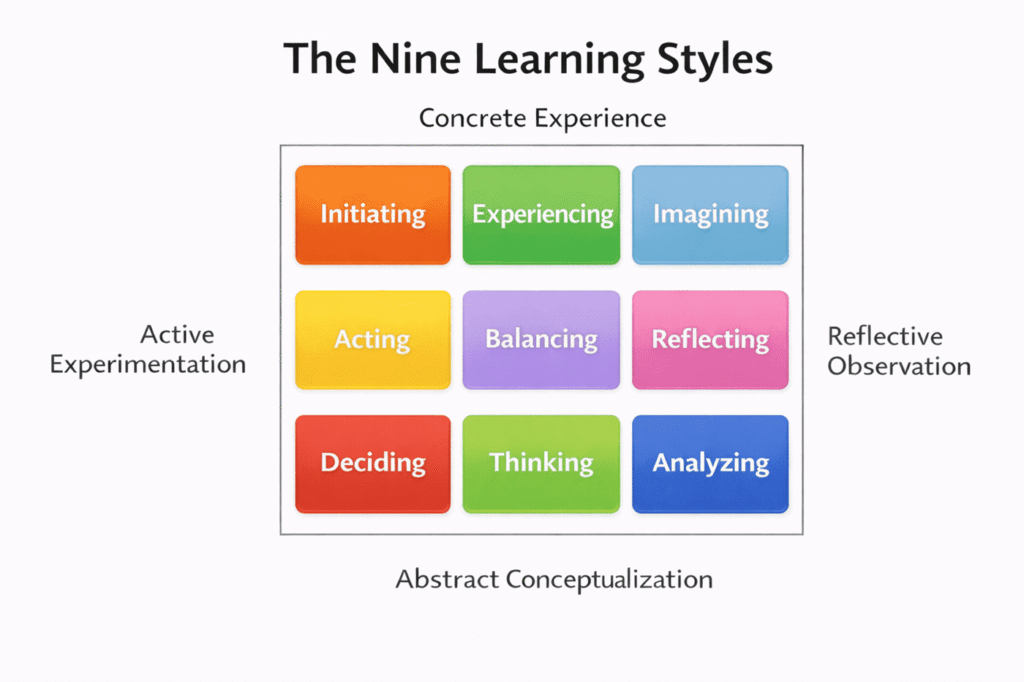
Kolb designed the Learning Style Inventory tool to help learners and facilitators understand how different individuals learn. The tool includes nine learning styles arranged on two axes, Concrete Experience-Abstract Conceptualization and Active Experimentation-Reflective Observation.
The nine learning styles are:
- Experiencing
- Imagining
- Reflecting
- Analyzing
- Thinking
- Deciding
- Acting
- Initiating
- Balancing
Earlier thinkers such as John Dewey and Carl Rogers also emphasized learning through experience, reflection, and personal meaning. While this academic foundation is important, its real value lies in how it informs practical design—not theory for theory’s sake.
Experiential vs Immersive vs Traditional Learning
Experiential, immersive, and traditional learning can be used in tandem or for different projects and goals.
Comparing Learning Types
Integrating experiential learning into other learning models, such as immersive and traditional methods, provides a holistic approach.
Immersive vs. Experiential learning
Experiential learning generally involves hands-on practice in the real world. However, technology has made it possible to incorporate virtual reality tools into the learning environment. The resulting immersive learning process can provide similar benefits to typical experiential learning methods.
As an added benefit, VR tools facilitate learning skills that might be difficult to teach in other ways. For example, medical and nursing students might use VR technology to practice techniques on virtual patients. This enables them to get a type of hands-on experience earlier in their training without involving real patients or human actors.
How Experiential Learning Differs From Traditional Teaching Methods
Traditional teaching methods place control in the hands of the instructor, who typically determines the goals, metrics, and method of instruction. Experiential learning, in contrast, focuses on the actions of the student. Learners are encouraged to identify their own goals, actively engage with a learning task, offer feedback on the experiential learning process, and above all, to engage directly in learning by doing.
This kind of traditional instruction can be seen as the opposite kind of learning process, and it has its place. For example, let’s say you have a team that needs updated information on compliance, regulatory, or legal issues. You might need to incorporate traditional instruction to impart some of that knowledge.
However, to ensure that your team engages with this information, you can add an experiential element like interactive quizzes or surveys that evaluate their retention.
Benefits and Outcomes
The benefits of experiential learning accrue to both participants and their organizations.
Evidence and Impact
Experiential learning has a measurable impact on outcomes for both students and professionals. The National Association of Colleges and Employers’ annual Early Career Talent Survey consistently shows that students who engage in service learning projects like internships and undergraduate research have better career outcomes. These include faster career progression, higher job satisfaction, and an average of $15,000 more per year in salary.
For professionals and their employers, hands-on training continues to offer benefits long after formal education has concluded. Gallup research shows employees who know their strengths are six times more engaged than their peers; they’re also significantly less likely to leave their organization.
Hands-on skills training can also help employees develop transferable skills, enabling them to take their career in a new direction if the market shifts.
Experiential Learning Activities and Real World Applications
Skills development is especially challenging for the distributed workforce. However, technology offers new tools to help.
Workplace Projects
Remote and hybrid teams face obvious challenges when deploying experiential learning programs. Unlike on-site business units, they can’t just gather in a room.
However, technology has made it possible to adapt hands-on learning even in remote environments. There are even benefits to meeting virtually.
A few examples:
- Chat functions can enable more private side chats and questions from learners who might otherwise be reluctant to speak up.
- Animated avatars can make participation easier for camera-shy learners and instructors.
- Asynchronous and synchronous functions combine to allow participants to attend on a flexible schedule, while still enabling groups to “gather” virtually to form learning cohorts.
Non-Profit and Higher Ed Workplaces
Experiential education techniques can help you develop employees regardless of your industry or sector. However, the way in which you deploy these tools will differ depending on your goals, culture, and workforce requirements.
For example, a non-profit might use mentoring circles to solve specific challenges by connecting employees with unique skillsets. Meanwhile, higher ed incorporates work-based learning into college curricula to provide students with on-the-job experience as well as help them develop skills.
Continuous learning is a requirement for jobs that rely on fast-evolving technologies. In the tech world, for example, it’s common for employers to offer development benefits, including hands-on training. Amazon has upskilled over 425,000 employees since 2019. The e-commerce giant also offers a mentorship program with 160,000 participants.
Experiential learning is especially helpful in high-pressure environments like healthcare. Students and skilled practitioners alike can develop their practice in a safe environment using hands-on tools like patient simulators.
Bringing It All Together
For enterprises navigating hybrid work, rapid change, and ongoing skills gaps, experiential learning isn’t a “nice to have.” It’s a practical way to build capability at scale.
When learning is embedded in real work—and reinforced through mentoring, job shadowing, and structured reflection—it becomes part of how the organization operates, not an extra initiative employees struggle to fit in.
That’s how learning moves from concept to culture.
Share this post:
|