5-Step Guide for Successful Mentorship Programs

Jump to:
Key Takeaways
What Makes an Effective Mentorship Program?
A mentoring program is a structured initiative designed to pair experienced individuals with less experienced ones to provide guidance, support, and knowledge transfer. Typically, formal mentoring programs are structured around defined objectives, timelines, matching criteria, and measurement methodologies to ensure effectiveness. Below are a few examples and best practices for launching successful mentoring programs, and in contrast, tips on what contributes to unsuccessful mentoring programs.
Successful mentoring programs
What makes a good mentoring program? Leading organizations have demonstrated the transformative power of well-designed mentoring initiatives. For example, Amazon’s mentoring programs showcase how strategic mentorship supports employee career growth at scale. Successful programs share these characteristics:
Unsuccessful mentoring programs

Why Start a Mentoring Program?
Mentoring is a powerful practice that facilitates learning, development, and growth in individuals and organizations. The benefits of mentoring programs make it a valuable investment for companies as a way to unlock personal and professional skill development and advancement.
According to a CNBC survey, the advantages of mentorship extend beyond only benefiting the mentor and mentee. Happy, productive employees are an asset to any company, as they are more likely to stay with the organization for an extended period. The survey also revealed that over 40 percent of workers without a mentor have contemplated leaving their jobs in the past three months, contrasting with only 25 percent of those who have a mentor. In the State of Coaching and Mentoring Report, HR.com found:
- 67 percent of HR professionals feel mentoring leads to improved organizational performance
- More than 50 percent also agreed their organization will place greater importance on coaching and mentoring over the next two years to combat feelings of isolation, burnout, and stagnation.
Key mentoring statistics:
Employees with mentors are twice as likely to strongly agree that they’ve had opportunities to learn and grow at work (Gallup). The purpose of mentoring depends on the organization’s goals and objectives. But mentoring programs have been proven to:
Mentoring at work increases retention rates
An extensive case study conducted by Sun Microsystems found a direct correlation between employees who participated in mentorship programs and higher retention rates, with 72 percent of mentees and 69 percent of mentors staying with the organization compared to 49 percent of non-participating employees. Furthermore, a CNBC/SurveyMonkey found that 9 out of 10 workers with a mentor said they were satisfied with their jobs; more than half rated themselves “very satisfied.”
Accelerate career advancement
Mentorship programs offer a myriad of benefits for employees who actively participate in them. Firstly, they facilitate personal development by providing individuals with guidance, support, and constructive feedback, fostering self-awareness and continuous improvement. Through structured interactions with mentors, employees gain valuable insights into their strengths, weaknesses, and areas for growth, enhancing their overall effectiveness and confidence.
Drive employee development
Additionally, mentorship programs contribute to employee development by nurturing talent, boosting morale, and promoting a culture of learning and collaboration within organizations. Mentors serve as role models, helping mentees navigate career challenges, identify opportunities, and set realistic and achievable goals. By pairing experienced mentors with mentees, these programs facilitate knowledge transfer, skill acquisition, and professional growth. Implementing employee development solutions through mentoring creates measurable impact on organizational performance.
Build leadership skills
Through regular discussions and goal-setting exercises, mentees gain clarity on their career aspirations and develop actionable plans to achieve them. Mentorship programs offer a safe space for experimentation and reflection, which empower individuals to develop their leadership capabilities, inspiring confidence and readiness to assume leadership roles in their respective fields.
Improve org culture
Mentoring fosters an inclusive environment by providing underrepresented individuals with guidance and support, helping them navigate challenges and seize opportunities. Through mentorship, diverse perspectives are amplified, leading to a richer exchange of ideas and solutions within organizations. By empowering marginalized groups through mentorship, barriers to advancement are dismantled, contributing to greater inclusion across all levels of the workforce.
In essence, mentoring is an invaluable asset for enterprise organizations, nurturing talent, enhancing employee satisfaction, and bolstering overall success. Organizations looking to build effective employee engagement strategies should consider mentoring as a cornerstone initiative.
Increase retention by 20% with Chronus mentoring software.
How to Start a Successful Mentoring Program
Want to learn how to develop a mentoring program? That’s great. Mentoring is a proven approach to drive rich learning and career development for both mentees and mentors. Mentoring also benefits the organization.
For employers, mentoring increases talent retention, promotion rates, and employee satisfaction for mentors and mentees. Companies can also leverage mentoring as part of an effective employee onboarding program to accelerate new hire integration and productivity.
University mentoring is proven to improve student retention, boost job placement rates, and increase alumni engagement when tapping alumni as mentors.
Watch a quick overview video
Starting a mentoring program is within your reach. But great mentoring programs don’t just happen. They are built through thoughtful planning and sustained commitment to guiding participants through the mentoring process while continually improving the program.
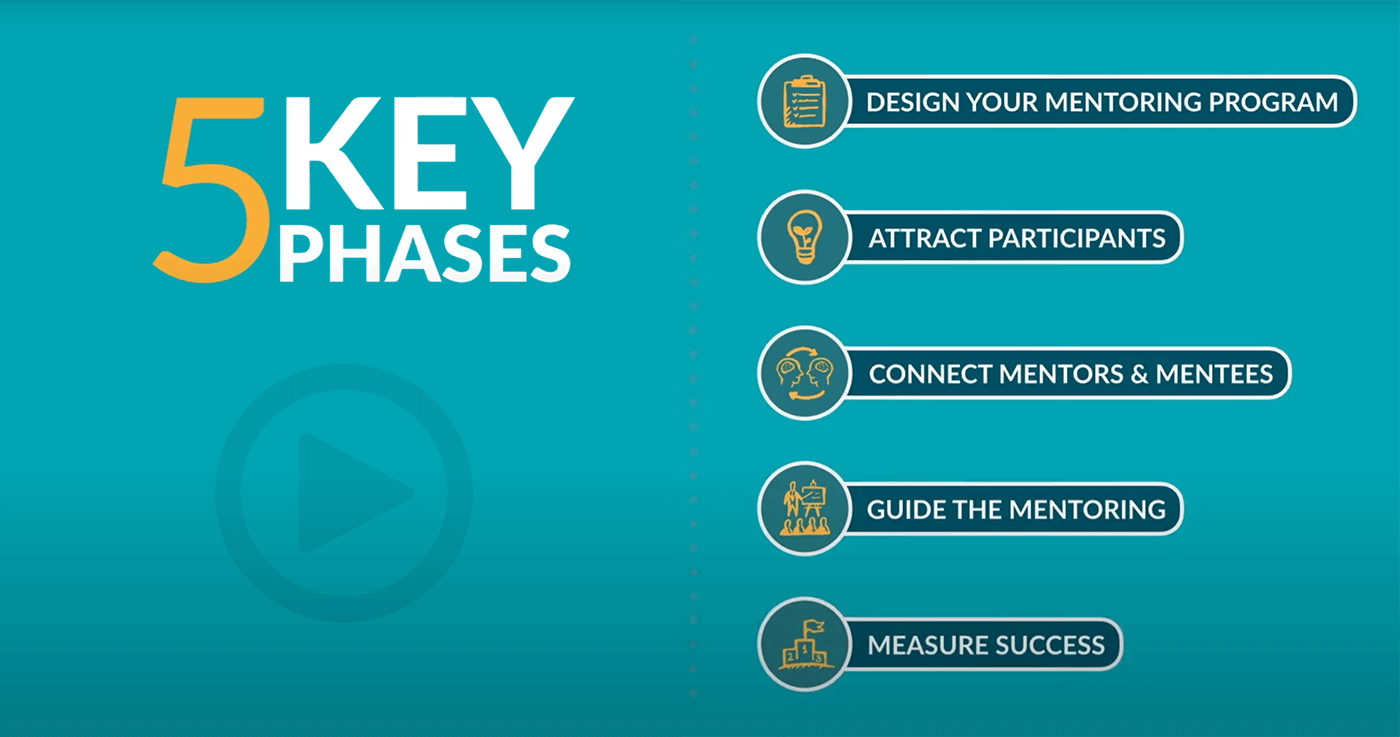
As with any major project, proper planning is crucial to achieving your strategic mentorship goals. Mentoring programs can be highly impactful, but there are many factors that are critical to the success of your program. We’ve distilled our guidance into a mentorship program outline video highlighting the five key strategies for building a mentorship program template.

Step 1
Design Your Mentoring Program
The starting point for any mentoring program template begins with two important questions:
- Why are you starting a mentoring program?
- What does success look like for participants and the organization?
To answer these questions, you will need to dive deep to understand your target audience. Make sure you understand who they are, where they are, their development needs, and their key motivations to participate. Translate your vision into SMART objectives: specific, measurable, attainable, relevant, and time-bound. Some of the perks of creating mentoring objectives include providing direction to program participants, establishing program key performance indicators (KPIs), and helping organizational leaders understand why they should offer their support.

Successful mentorship programs offer both structure and flexibility. Structure provides participants with a mentoring workflow to follow. This is critical to helping participants achieve productive learning that reaches defined mentorship goals. Similarly, flexibility is essential to support varying individual mentoring needs across specific learning goals, preferences, and learning styles.
Key mentoring program design decisions include:
- Enrollment – is it open, application, or invite only?
- Mentoring style – can be traditional, flash, or reverse
- Connection type – possibly 1:1, mentor groups, or one-to-many
- Connection duration – can be weeks or months or perhaps even just a single session
- Measurement – tracking and reporting needs.
A good idea is to create a program workflow diagram to explain each step of your mentoring program. You can provide details such as key actions, timeframes, support resources, and criteria for moving to the next phase. Mark areas that will require some flexibility to support user needs.
Mentoring software allows you to deliver a wide-variety of mentoring programs. Regardless of program size, easy-to-use mentoring software can help get your mentorship program started and running smoothly.
Learn how software walks you through mentoring program design
Step 2
Attract Participants for Your Mentoring Programs
The best-designed mentoring programs won’t get far without effective program promotion, mentor recruitment, and mentoring training.
When formal mentorship programs are introduced in organizations, there is generally natural enthusiasm. Yet this enthusiasm doesn’t always translate into high participation rates. A common reason is poor promotion of mentoring programs. Don’t assume potential mentors and mentees understand the benefits. For many, this will be their first opportunity to participate in mentoring. You will need to demonstrate the benefits of mentorship programs to show that participating is worth the time and effort, and educate key leaders and stakeholders on the benefits of the program and strategic value to the organization.
Building a solid base of mentors can be a challenge, so consider the needs of the mentors:
- How can you help mentors be more efficient with the time they have to dedicate to mentoring?
- Formally recognize mentor involvement to motivate and attract additional mentors to the program
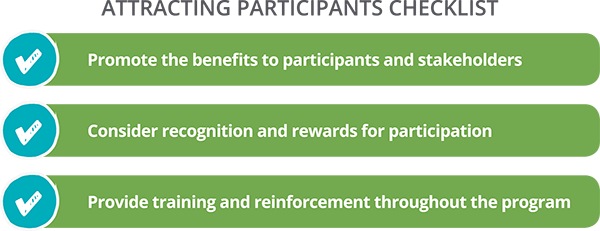
Lastly, productive mentoring doesn’t just happen. Provide mentorship training to mentors and mentees regarding:
- Mentorship program goals
- Mentoring participant roles
- Mentoring best practices
- Your organizational mentoring process
- Clarifying mentor and mentee mentoring objectives
The need for mentoring training and guidance doesn’t end after the initial orientation. Provide tips and best practices throughout the mentoring program to help participants stay on track and get the most out of the program.
Get the eBook Now
Download the Free eBook to Take on the Go
Step 3
Match Mentors and Mentees
A productive mentoring relationship depends on a good match. Properly matching mentors and mentees is often one of the most challenging aspects of a program. Participants will bring various competencies, backgrounds, learning styles, and needs. A great match for one person may be a bad match for another.
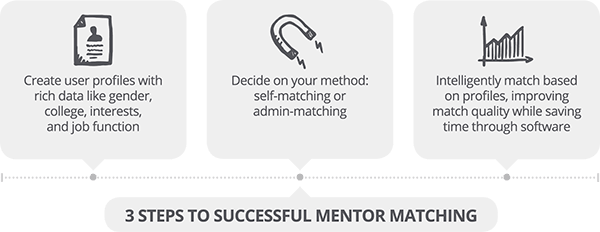
Three steps to successful mentoring matching:
- Create user profiles with rich data like demographics, tenure, location, interests, and job function
- Decide on your method: self-matching or admin-matching
- Intelligently match based on profiles, improving match quality while saving time through mentoring software
Building Your Matching Criteria
Matching participants in a mentorship program requires a thoughtful approach that centers on aligning individuals’ goals with the program’s objectives. Understanding the wants and needs of participants is key; this involves considering factors such as career aspirations, industry experience, and personal interests. In addition to building your matching criteria, DEI considerations play a pivotal role in the matching process too. When aiming for diverse mentor-mentee pairs across gender, ethnicity, location, and other dimensions, program organizers must prioritize inclusivity to promote a supportive and inclusive environment.
Leveraging software solutions like Chronus can streamline this process, offering customizable criteria that take into account participants’ preferences and DEI considerations. By incorporating software tools, program coordinators can enhance the likelihood of successful matches, ultimately maximizing the impact and effectiveness of the mentorship program.
Choosing Your Matching Style
Matching starts by deciding which type of matching you’ll offer in your program: self-matching or admin-matching. Consider allowing mentees to select a particular mentor or submit their top three choices. Self-matching is administrative light, which in larger programs can be a huge plus.
Additionally, mentor styles play a significant role in determining the compatibility of a match. Factors such as communication approach, leadership style, and mentoring philosophy can influence the dynamics between a mentor and their mentee, ultimately shaping the effectiveness and satisfaction of the mentoring experience. By carefully considering these elements, mentoring programs can facilitate matches that maximize mutual learning, growth, and support.
For more structured programs, such as large groups of new students or new corporate employees, you may want to get the program started by bulk or admin matching. Utilizing software for mentor matching can be valuable. For organizations managing very large groups, AI-powered mentor matching helps evaluate various match combinations before finalizing and ensures quality mentors for hard-to-match mentees.

Matching Best Practices
The mentoring matching process is a delicate yet crucial step in ensuring the success of a mentorship program. It begins by meticulously assessing the profiles of both mentors and mentees, taking into account factors such as development goals, interests, experiences, and preferences. Matching suitable mentors and mentees involves aligning their objectives, expertise, and personalities to create a productive and harmonious relationship.
It’s important to remember that matching best practices start with a solid profile for all participants (mentors and mentees). Critical profile elements include:
Think about how you’ll want to match people, or if you’ll want them to match themselves. For example, you may want to match female leaders with younger female employees, or experienced sales personnel with new recruits. For self-matching, perhaps participants might like to connect with someone from the same previous employer or the same college. The more you know about your participants, the better the chance your program will have a positive outcome.
Regardless of self or admin matching, see how the Chronus platform makes matching faster and easier with strong, intelligent matching capabilities.
How Chronus mentor matching works
Software can drive 50% increased engagement. Learn how.
Step 4
Automate Mentoring Relationship Guidance
Now that your participants are enrolled, trained, and matched, the real action begins. It is also where mentoring can get stuck. Left to themselves, many mentorships will take off and thrive. But some may not. Why? Because mentoring is not typically part of one’s daily routine. Without direction and a plan, the mentoring relationship is vulnerable to losing focus and momentum. That is why providing some structure and guidance throughout the mentorship is vital to successful mentoring programs. Chronus offers intelligent solutions to automatically prompt your team to establish the purpose, set agendas, discuss goals, and get to know each other.
One best practice in successful mentoring programs is to ensure all mentorships have goals and action plans. This serves two purposes:
- It brings focus at the onset, which helps a mentoring relationship get off to a good start.
- It adds accountability to accomplish something.
Whether you are doing it yourself or using a tool to help automate elements, such as goals and action planning, setting this standard for all mentor/mentee pairs will help you launch a successful mentorship program that can accomplish big things. Provide all mentoring relationships with timely and relevant “help resources” (topical content, mentoring best practices, etc.) throughout the mentorship. Bite-sized content delivered at key points is ideal. Modern mentoring platforms offer real-time virtual guidance for mentors and mentees, providing conversation starters and discussion frameworks that keep relationships productive and focused.

As a mentoring connection progresses, establish checkpoints where mentorships report on their progress. Lastly, have a formal process that brings closure to the mentoring experience. This process should account for:
Chronus mentoring software makes guiding or facilitating your program’s connections easy, enabling your participants to be highly productive.
Guidelines for mentors and mentees
Step 5
Measure the Impact of Mentorship Programs
Understanding how your program measures up to expectations may well be the most important phase of all.
Starting a mentorship program is a significant investment when you consider program management, infrastructure, and the valuable time of participants. Articulating the ROI of mentoring is essential to secure ongoing funding and support. In addition, the measure phase is also focused on assessing program health to identify trouble spots and opportunities.
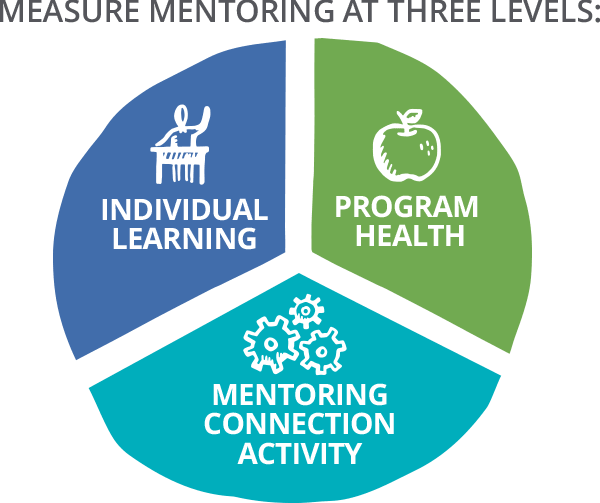
Successful mentorship programs should be tracked, measured, and assessed at three altitudes: the program, the mentoring connection, and the individual. To be effective, you need the ability to capture metrics and feedback throughout the program lifecycle.
At the program level, build metrics around defined business objectives. For example, in a career mentorship program you may want to compare promotion rates of program participants to non-participants. Also track “funnel” conversion metrics, which show the progress participants make at each step of the mentoring program, starting at enrollment. Conversion metrics provide essential insight into program health.
For mentoring connections, you want to understand mentorship behavior to identify roadblocks and opportunities. Common questions you will want to ask are:
- Is the mentoring timeframe too long, too short, or just right?
- Are mentorships getting off to productive starts or lagging behind?
- Are participants leveraging the content resources you have provided?
For participants, you want to understand the impact of mentoring in terms of outcomes while acquiring program feedback. One of the easiest ways to capture outcomes and feedback is through surveys. Ask participants and stakeholders how well the mentoring program met its goals and the goals of the organization. Also, ask them for their ideas for improving the program.
You’ll also want to be sure you’re benchmarking your mentoring program in the areas of enrollment, matching, and engagement, so you’ll understand if the performance you’re seeing is good, bad, or average in comparison to other mentorship programs.
Not sure how to establish benchmarks? Check out our Mentoring Benchmarks Report: Quit Navigating in the Dark.
Examples of program reporting and mentoring success
What Are 3 Types of Mentoring Formats?
When you think of mentor-mentee programs, what comes to mind? There are many types of mentoring that drive development, growth, and connection. The important thing is to decide which mentoring format is right for your organization and its people. Here are a few to consider.
Employee Career Mentoring
Offering formal career development is a tangible way to show employees that their career trajectory matters. Career mentoring is by far the most common mentoring program we see in the workplace. This traditional one-to-one mentoring relationship can last six to 12 months. Employees get the opportunity to learn and build skills, which can help grow their careers, keeping them from feeling stagnant in their roles.
Reverse Mentoring
This format pairs a more senior employee with a more junior employee. Companies can implement reverse mentoring in a one-to-one or group setting. The younger employee serves as the mentor, providing senior members of the organization with up-to-date information on the latest frontline experiences, technical skills, and workplace culture.
Mentoring Circles
A mentoring circle is a peer-to-peer format, similar to group mentoring, that enables employees to find peers who share common interests or learning objectives, and develop together as a group. People from across departments and generations can learn from one another, expanding institutional knowledge.
Reduce Admin Time & Improve Impact with Software
Formal mentorship is an impactful strategy to develop, engage, and retain your people. But to do it at scale—beyond a program of a few dozen people or even just 100 people—you’ll need the right platform that can design, match, and measure your participants across teams, departments, locations, and beyond into the thousands or tens of thousands of participants.
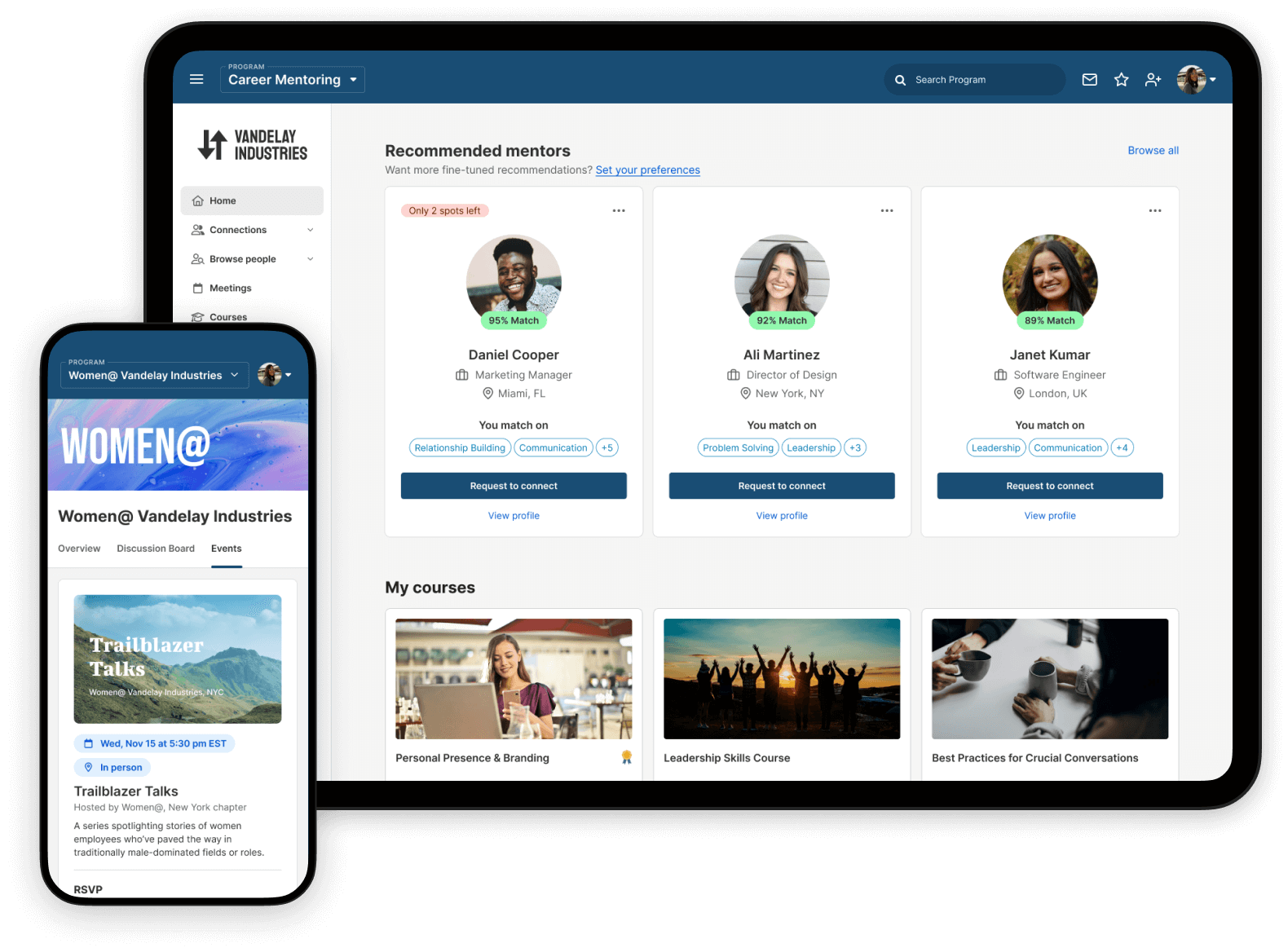
To effectively manage the complexities of a large-scale mentoring program, customizable matching offered by mentoring software becomes instrumental. In fact, mentoring software allows for tailored mentor-mentee pairings based on specific competencies, backgrounds, demographics, and individual needs, ensuring optimal matches for inclusive mentoring. But it’s not just about the matching. A robust mentoring software should be able to:
Utilizing mentoring software to create lasting structure and accountability in your program can add immense value to your mentoring strategy. Simplify the complex with Chronus mentoring software! Get started today.
In Conclusion
Become a Mentorship Program Founder
Formal mentorship is an impactful strategy to develop, engage, and retain your people. Now you’ve learned everything about how to create a mentorship program. Following our mentoring program guidelines laid out in this five-step process will put you on the right path to achieve your organization’s learning and mentorship goals. Developing and implementing a successful mentoring program requires careful planning and commitment. The benefits of such programs are evident, with positive impacts on talent retention, promotion rates, and employee satisfaction for employers.
The process of starting a mentoring program involves key steps, including:
Thoughtful consideration of each step, from setting SMART objectives to providing mentorship training, is crucial for building a program that not only meets its goals but also contributes to the overall success and development of participants.
Finally, measuring the impact of mentorship programs at various levels — individual, program, and connection — is essential for articulating the ROI of mentoring, identifying areas for improvement, and ensuring ongoing support and funding. Overall, the success of a mentoring program hinges on a well-thought-out strategy, ongoing support, and a commitment to fostering meaningful connections bent on people-centric development. Organizations will often celebrate these successes during National Mentoring Month each January, recognizing the profound impact mentoring has on individual careers and organizational success.
Frequently Asked Questions About Mentoring Programs

Ready to See the Chronus Platform for Yourself ?